
Palmerston North & Manawatū
Lawn renovation & treatments
We assess your lawn first, then do only what it needs, from a single treatment to a full renovation.
Signs your lawn needs renovating
One or two of these can often be fixed with a single treatment. If you're seeing several, a full renovation usually gets better value than fixing them one at a time.
Not sure which? Take the 1-minute lawn check- Moss and matted growth that won't go away
- A spongy feel underfoot, or water sitting on top
- Hard ground and puddles after rain
- Bare or thin patches, with weeds moving in
- Bumps, dips and an uneven surface
- Pale grass that's slow to grow
Our lawn renovation process
Not every lawn needs every treatment. We build each renovation around the condition of your lawn, so you only pay for the steps it needs.
First, we assess
We look at weeds, thatch, compaction, surface levels, drainage, sunlight and foot traffic. Your written quote lists the steps your lawn needs. Free in Palmerston North only.
Weed control If needed
We treat unwanted weeds where needed. A lawn that's badly infested with weeds may need a full renovation.
Mow and scarify Scarify if needed
We mow the lawn low and remove the clippings, then scarify to remove excess thatch and dead material, preparing the surface for renovation.
Aerate the soil If needed
Core aeration relieves soil compaction and improves how water, air and nutrients move through the soil.
Level and topdress If needed
Quality screened topdressing fills low spots and improves surface levels. We brush or drag it evenly across the lawn.
Starter fertiliser
A suitable starter fertiliser supports seed germination and healthy grass establishment.
Overseed
We choose a grass seed suited to your lawn's conditions, including sunlight, soil, drainage and foot traffic, and spread it evenly across the prepared surface.
Roll and water
A light roll improves seed-to-soil contact. Water regularly to keep the soil consistently moist while the new grass germinates and establishes.
First mow
Once the new grass reaches about 75 mm, it gets its first mow. Take off only the top third of the blades so the new growth isn't stressed.
Follow-up fertiliser
Around six weeks after seeding, a follow-up fertiliser supports continued growth and lawn development.
Ongoing lawn care
A consistent mowing and watering routine keeps an established lawn thick, healthy and looking its best. Our 4-Season Nutrient Plan keeps it fed through the year.
What makes a renovation work
A renovation gives new grass the best possible start. How it finishes depends on what happens over the following weeks, so we're upfront about that before we start.
If a lawn isn't suited to what you'd like, we'll tell you before any work begins.
Watering
New seed needs to stay moist while it establishes. You'll get clear watering instructions.
Weather
Heavy rain, frost, drought and heat all affect timing. We'll move a job rather than do it in the wrong conditions.
Keeping off it
Foot traffic and pets on newly seeded areas set the lawn back.
What's underneath
Some problems, like buried rubble or drainage faults, only show up once work starts. We'll talk to you before doing anything extra.
Lawn treatments
Each treatment fixes a different problem. Tap one to see what it fixes, when to do it and which package includes it.
Weed controlWeeds spreading through the lawn and into bare patches
We treat unwanted weeds where needed, before they take over the gaps in a lawn. It's often the first step of a renovation.
A lawn that's badly infested with weeds may need a full renovation rather than spraying alone. Products are applied as the label directs. Tell us about pets, children, ponds or sensitive plants nearby.
- Look for
- Weeds spreading through the lawn and into bare patches
- When
- Before overseeding, or as part of regular care
ScarifyingMoss, matted growth, grass that won't thicken up
A scarifier's blades cut into the surface and pull out moss, dead grass and creeping runners. It makes room for new grass to grow.
Expect the lawn to look rough for a few weeks afterwards while new growth comes through. That's normal. Scarifying is usually followed by overseeding.
- Look for
- Moss, matted growth, grass that won't thicken up
- Best time
- Autumn, or spring once the grass is growing well
DethatchingA spongy feel underfoot, water sitting on top after rain
Thatch is the layer of dead stems and roots between the grass and the soil. A little is fine. Too much acts like a sponge: it holds water at the surface and stops air and fertiliser getting down to the roots.
Dethatching rakes that layer out so the soil can breathe again.
- Look for
- A spongy feel underfoot, water sitting on top after rain
- Best time
- Autumn or spring, while the grass is growing and can recover quickly
- Part of
- Spring Reset, full lawn renovation
AerationHard ground, puddles after rain, worn paths, thin grass where people walk
Aeration makes holes through compacted soil so air, water and fertiliser can reach the roots, and roots can grow deeper. Core aeration lifts out small plugs of soil. Solid-tine aeration pushes holes without removing soil.
Aeration is part of our Autumn Renovation package, or we can do it on its own.
- Look for
- Hard ground, puddles after rain, worn paths, thin grass where people walk
- Best time
- Autumn or spring, when the soil is moist but not waterlogged
OverseedingBare patches, thin areas, weeds moving into the gaps
Overseeding sows new grass seed into your existing lawn to fill gaps and thicken it up. It works best straight after scarifying or aeration, when the seed can reach the soil.
We choose seed to suit your lawn's sunlight, soil, drainage and foot traffic. After sowing, a light roll improves seed-to-soil contact. Keep the soil consistently moist while the seed germinates, and keep feet and pets off it.
The first mow is once the new grass reaches about 75 mm. Take off only the top third of the blades.
- Look for
- Bare patches, thin areas, weeds moving into the gaps
- Best time
- Autumn is ideal. Spring works once the soil has warmed up.
TopdressingBumps, dips and an uneven surface
Topdressing spreads a thin layer of fine soil or sand mix over the lawn. It fills small hollows, evens out the surface and gives new seed a good bed to grow in.
The material settles over the following weeks as the lawn grows through it, so the surface keeps improving after we leave.
- Look for
- Bumps, dips and an uneven surface
- Best time
- With overseeding or after aeration, in autumn or spring
- Part of
- Patch Fix, full lawn renovation
FertilisingPale or yellowing grass, slow growth
Fertilising feeds the lawn the nutrients it needs for the time of year. Well-fed grass grows thicker, which leaves less room for weeds and moss.
In a renovation, a starter fertiliser goes down at seeding to support germination, and a follow-up feed around six weeks later keeps the new grass growing.
Products are applied as the label directs. Tell us about pets, children, ponds or sensitive plants nearby so we can plan around them.
- Look for
- Pale or yellowing grass, slow growth
- Best time
- Through the growing season, matched to what the lawn needs
Where each treatment works
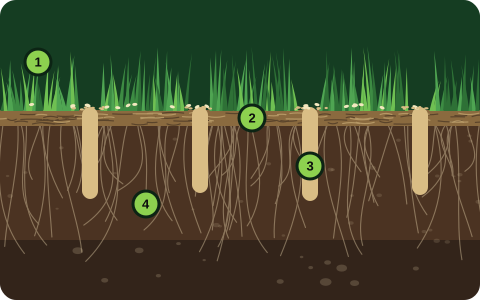
- Grass & new seedOverseeding thickens up thin cover.
- ThatchScarifying and dethatching clear it out.
- Aeration holeFilled with topdressing so air and water get in.
- Root zoneFertilising feeds it for stronger growth.
Best time to renovate
Best time to renovate
Autumn is the main window. The soil is still warm and the rain returns, so new seed establishes quickly. Spring is a good second option once the soil warms up.
Autumn (March–May): main window Spring (September–November): good
More on each service
-
Lawn renovation
For thin, mossy, weedy or spongy lawns. We assess first and only do the steps your lawn needs.
Read more -
Lawn aeration
Opens up hard, compacted soil so air, water and fertiliser reach the roots.
Read more -
Scarifying and dethatching
Clears out moss, dead grass and thatch from matted or spongy lawns.
Read more -
Overseeding and topdressing
Fills bare patches, thickens thin lawns and levels bumps and dips.
Read more -
Weed control and fertilising
Keeps the lawn thick and green, with less room for weeds and moss.
Read more
Not sure what you need?
We'll look at the lawn and recommend only what it needs. Free in Palmerston North only. Or try our 1-minute lawn check.